
 English
 中文简体
中文简体
Stand in a traction elevator lobby and watch the floor indicator: for every floor the cab climbs, a stack of grey plates somewhere behind the shaft walls drops by the same distance. That stack is the counterweight, and it is the reason a typical elevator motor is far smaller than the job it performs. The sizing logic comes down to one line: an elevator counterweight is filled to equal the car's own deadweight plus roughly 40–50% of its rated load. Balanced this way, the traction machine mostly lifts the difference between the two sides, not the full weight. For buyers and maintenance planners, the counterweight side of the hoistway also matters for a practical reason: it runs on its own guide rails through counterweight guide shoes, and those wear parts directly affect ride quality, rail life and service cost.
Content
- 1 What an Elevator Counterweight Actually Does
- 2 The Counterweight Weight Formula: W = P + C·Q
- 3 Cast Iron, Concrete or Compound: Choosing the Fill
- 4 Why the Balance Coefficient Sits Near 0.45
- 5 The Frame, the Rails and the Counterweight Guide Shoes
- 6 Counterweight-Side Maintenance Checklist
- 7 Elevator Counterweight FAQ
- 7.1 Q1. How heavy is an elevator counterweight?
- 7.2 Q2. Why do elevators have counterweights?
- 7.3 Q3. What is the balance coefficient of an elevator?
- 7.4 Q4. What are elevator counterweights made of?
- 7.5 Q5. What guides the counterweight in the hoistway?
- 7.6 Q6. What happens if the counterweight is set wrong?
- 7.7 Q7. Where is the counterweight located?
- 7.8 Q8. How often should counterweight guide shoes be serviced?
What an Elevator Counterweight Actually Does
In a traction system, the suspension ropes pass over a grooved sheave driven by the machine. The car hangs on one side; the counterweight hangs on the other. Because the two sides pull against each other over the same sheave, the motor only has to overcome the imbalance between them. When the car is lighter than the counterweight, gravity on the counterweight side helps pull the car upward; when the cab is fuller, the motor works harder. The machine never carries the whole car weight on its own.
- It cuts motor size and energy use, because peak demand drops to the difference between the two sides.
- It keeps the ropes pressed into the sheave grooves, which is what traction—the grip that moves the car—depends on.
- It stabilizes the system, since the counterweight acts as a steady reference load guided along fixed rails.
Isometric layout of a traction hoistway: the counterweight frame rides its own rails opposite the car.
The Counterweight Weight Formula: W = P + C·Q
Elevator design references use the same basic expression, often written as W = P + C·Q (or G + kQ in Chinese-language handbooks). P is the deadweight of the complete car assembly, Q is the rated load, and C is the balance coefficient—the share of rated load the counterweight is designed to offset. Industry practice puts C between 0.40 and 0.50, with many passenger elevators designed near 0.45.
Worked example: a car assembly weighing 1,300 kg with a rated load of 1,000 kg needs a counterweight of 1,300 + 0.45 × 1,000 = 1,750 kg. The chart below shows how that total is built up.
Worked example with illustrative figures: 1,300 kg car, 1,000 kg rated load, balance coefficient 0.45.
Two practical notes follow from the formula. First, the final figure is always set by the elevator manufacturer, because rope weight, travel height and rigging shift the arithmetic on taller rises—deep-travel installations add compensating ropes or chains to keep both sides equal along the full shaft. Second, never "top up" a counterweight casually: added plates change traction conditions and must match the OEM calculation.
Cast Iron, Concrete or Compound: Choosing the Fill
The frame is welded steel; the weight itself comes from filler plates or blocks. Manufacturer and industry references group counterweight fill into three families:
| Fill type | Density & form | Where it fits | Trade-offs |
|---|---|---|---|
| Cast iron | High density (about 7.2 g/cm3), compact plates | High-speed and high-rise elevators with tight frame space | Higher cost per kilogram; needs rust protection |
| Concrete | Lower density (about 2.4 g/cm3), bulky blocks | Low-rise, cost-driven installations with roomier frames | Can absorb moisture and crack; adds bulk to the frame |
| Compound | Iron plates combined with concrete or filler mix | Mid-range projects balancing cost and compactness | Quality depends on filler ratio and workmanship |
Density is the deciding factor: the same compensating weight takes far less frame length in iron than in concrete, which is why compact machine-room-less designs lean on metal plates.
Why the Balance Coefficient Sits Near 0.45
Real passenger elevators spend most of the day neither empty nor full. Traffic studies and design references commonly show average car loading in the 40–50% band, so a counterweight set at C = 0.40–0.50 keeps the system close to equilibrium for much of its working life. The effect on the machine is direct: the closer the two sides are in weight, the smaller the torque—and the current—the traction motor draws.
Illustrative plot derived from the balance formula: motor load ≈ |payload − C·Q|, normalized to rated load Q.
Read the two lines together and the value of counterweighting is obvious. Without one, the machine carries the car mass plus every kilogram of payload, all day. With a balance coefficient of 0.45, the load curve crosses zero near mid-load and stays modest across the whole range—which is why elevator training materials note that a counterweight roughly halves the effort needed to move a typically loaded car.
The Frame, the Rails and the Counterweight Guide Shoes
A counterweight is not a loose stack of plates. Steel plates or blocks are stacked inside a welded frame, locked with retaining rods, and suspended from the rope hitch. The whole frame then slides or rolls along counterweight guide rails through guide shoes mounted on its sides—the same guiding principle the cab uses, just with a lighter frame.
When those shoes wear, the symptoms travel straight into the ride: sway and horizontal vibration in the cab, knocking at landings, and accelerated wear on the counterweight rails. Worn boots also scratch the rail surface, which then wears out the car's own shoes faster—a chain reaction explained in more detail in this guide to how guide shoes prevent damage to elevator rails.
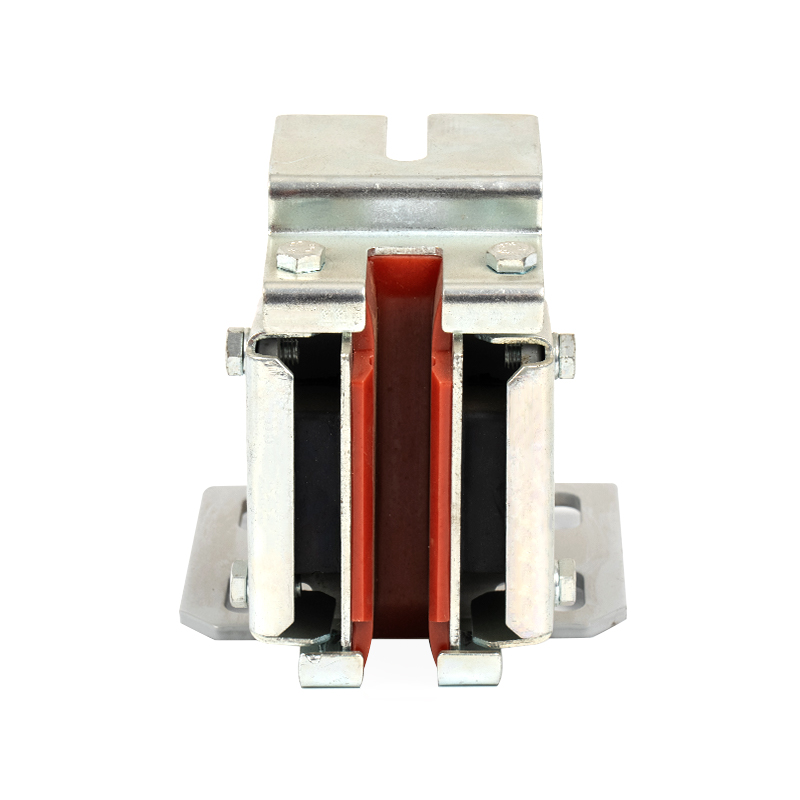
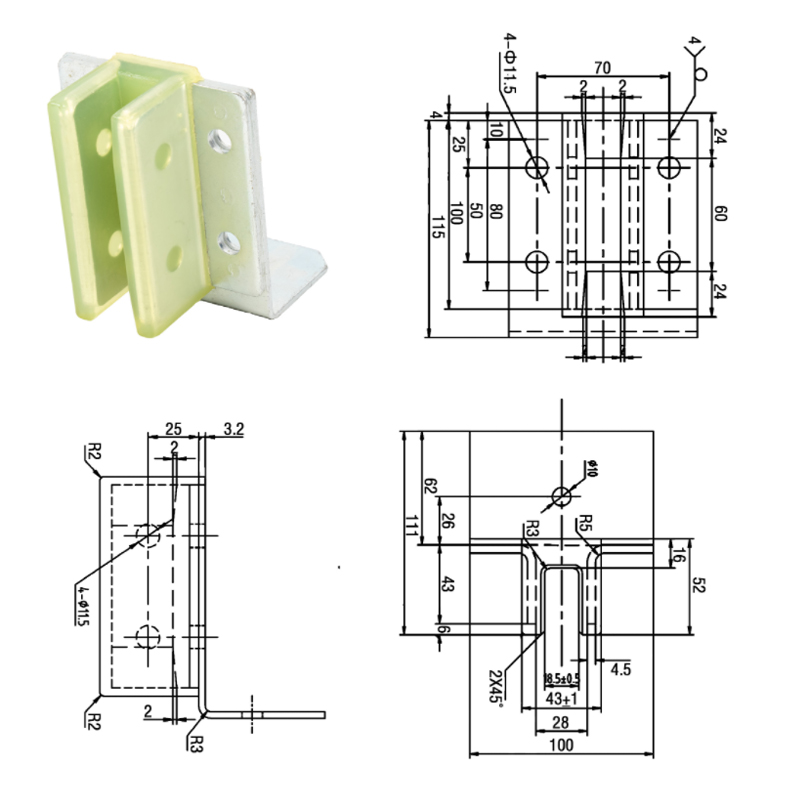 FKD-6757 Elevator Counterweight Guiding BootsA sliding counterweight boot for speeds up to 1.75 m/s, fitting 10 mm and 16 mm guide rails. Since worn shoes cause cab sway and rail scratching, this durable replacement helps stop that wear chain.View Product →
Sliding boots use a low-friction lining—often nylon or a polymer composite—pressed against the rail, and they remain the default on counterweight frames because they are economical, quiet and tolerant of dust. Roller shoes cut friction further and suit high-speed equipment. Where the two designs differ, and when to pick each, is covered in our comparison of sliding and roller elevator guide shoes.
Matching the Boot to the Brand and the Rail
Counterweight boots are dimensional parts: rail gauge, fixing hole spacing and lining width must match the frame and the OEM drawing. Because interfaces differ between platforms, boots are normally ordered by brand and model rather than by generic size. Fukangda, an elevator parts manufacturer supplying guide shoes and counterweight boots to major OEM customers since 2006, machines both sliding and roller types to brand-specific drawings, including the examples below.
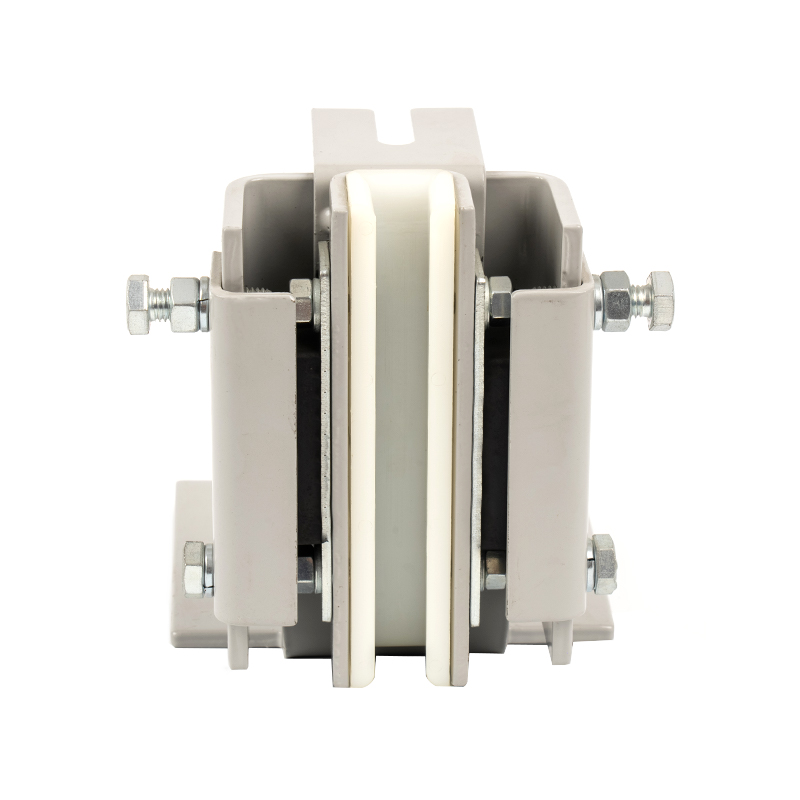
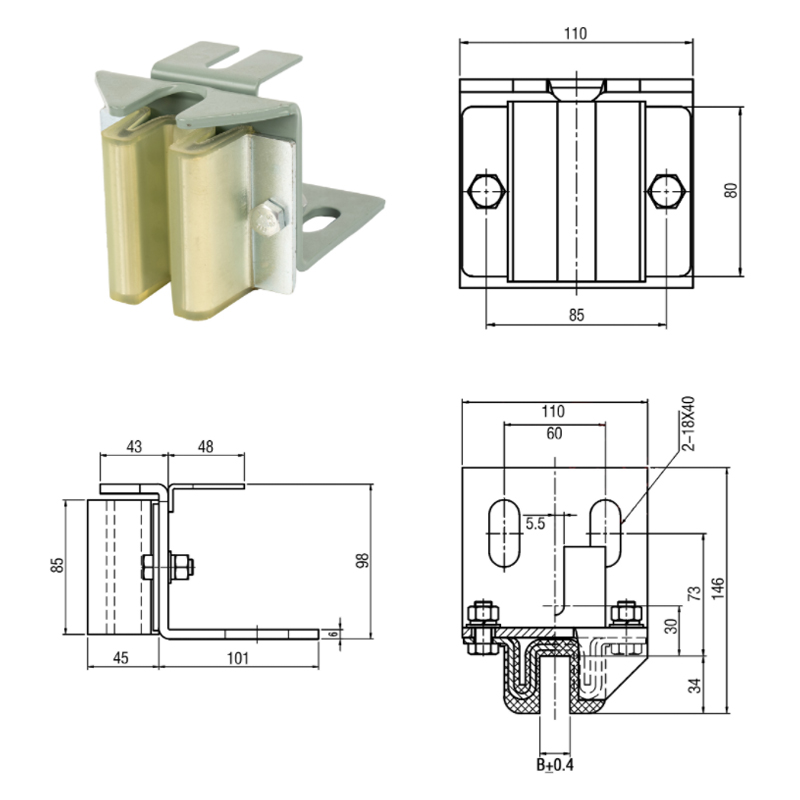 FKD-X24 Mitsubishi Counterweight Guide BootsA brand-specific sliding boot for Mitsubishi elevators up to 1.75 m/s, matching 10 mm and 16.4 mm rails. It shows how counterweight boots are ordered by OEM model to match frame dimensions.View Product →
 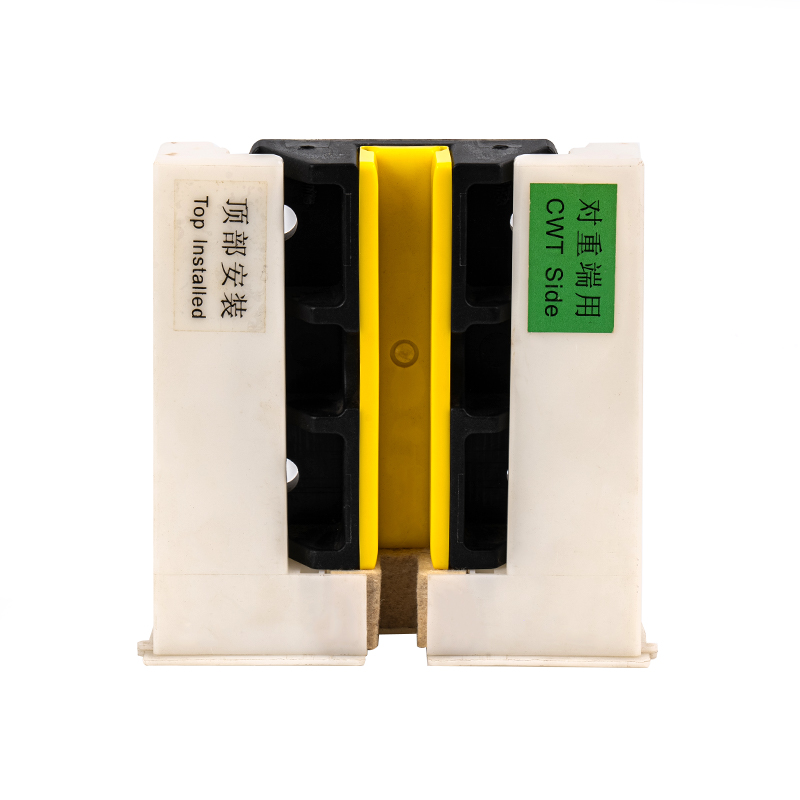 Thyssen Counterweight Guide BootsDesigned for Thyssen elevators running at 1.75 m/s or less with 16 mm guide rails, this boot guides the counterweight smoothly and quietly. It illustrates why OEM-matched dimensional parts matter.View Product →
Counterweight-Side Maintenance Checklist
The counterweight is set once at installation, but its running gear wears continuously. Service technicians typically cover these points during scheduled visits:
- Check frame bolts, retaining rods and plate condition—loose filler plates create noise and uneven loading.
- Inspect counterweight guide shoes: lining thickness on sliding boots, roller rotation and flat spots on roller types.
- Confirm rail lubrication where sliding shoes are used, and verify that oil cups feed correctly—oiled rails reduce lining wear, while oil on roller treads does the opposite.
- Check rope tension equalization at the hitch and the condition of compensating ropes or chains on taller rises.
- Verify pit condition and buffer clearance, especially after water ingress or refit work in the shaft.
Replacing guide shoe linings on time is the cheapest insurance on this list. The counterweight side of the hoistway is also the least visited, so wear there tends to be found late—build the check into every maintenance route rather than waiting for ride complaints.
Elevator Counterweight FAQ
Quick answers to the questions buyers, technicians and building managers ask most about elevator counterweights and related parts.
Q1. How heavy is an elevator counterweight?
Car deadweight plus 40–50% of rated load, so a mid-rise passenger elevator counterweight commonly weighs roughly one to three tonnes.
Q2. Why do elevators have counterweights?
The counterweight offsets the car's weight so the traction machine mainly lifts the difference, cutting energy use and allowing a much smaller motor.
Q3. What is the balance coefficient of an elevator?
The share of rated load the counterweight compensates for, normally set between 0.40 and 0.50 in standard elevator design practice.
Q4. What are elevator counterweights made of?
Most use cast iron plates, concrete blocks, or a compound frame that combines iron plates with a concrete or filler mix.
Q5. What guides the counterweight in the hoistway?
Counterweight guide shoes—sliding boots or roller shoes—run along dedicated counterweight rails to keep the frame stable and aligned.
Q6. What happens if the counterweight is set wrong?
An under-weighted frame overloads the motor at full load; an over-weighted one risks traction loss and jerky starts, so OEM figures must be followed.
Q7. Where is the counterweight located?
In the hoistway, on rails opposite the car, connected to it by suspension ropes that pass over the traction sheave.
Q8. How often should counterweight guide shoes be serviced?
At every scheduled elevator maintenance visit—check lining wear, roller condition and mounting bolts, and replace worn parts promptly.