
 English
 中文简体

One seized guide roller can turn a routine escalator inspection into an unplanned shutdown. The part is small, often hidden behind the step chain, and easy to treat as a commodity. That is the wrong buying logic. An escalator guide roller controls chain tracking, carries radial load, and sets the noise signature of the whole drive path. Specify it by drawing dimensions, bearing protection, tyre hardness, and batch consistency - then inspect it by sound, debris, and chain position. Price alone tells you very little.
Content
- 1 What an Escalator Guide Roller Actually Does
- 2 Sizing and Load: The Numbers That Matter More Than the Catalogue Picture
- 3 Materials and Bearing Seals: Where Quiet Operation Is Won or Lost
- 4 Failure Signs: What a Worn Guide Roller Sounds and Looks Like
- 5 Installation and Alignment Checks
- 6 Specifying Replacement Guide Rollers Without Guesswork
- 7 Maintenance Plan That Matches Escalator Duty
- 8 Frequently Asked Questions
- 8.1 Q1. What is an escalator guide roller?
- 8.2 Q2. How do I know if my escalator guide roller is bad?
- 8.3 Q3. Can I replace an escalator guide roller by size only?
- 8.4 Q4. What is the difference between a guide roller and an escalator step chain roller?
- 8.5 Q5. How often should escalator rollers be inspected?
- 8.6 Q6. When should I replace escalator rollers?
What an Escalator Guide Roller Actually Does
A guide roller is a rolling interface between a moving chain and a fixed track. On an escalator, it usually runs against a guide rail or chain guide, keeping the step chain or handrail drive chain in line. It does not carry the passenger load in the way a step roller does. Confusing the two is one of the most common specification errors.
| Part | Where it runs | Main job | Common failure cue |
|---|---|---|---|
| Guide roller | Chain guide track or handrail drive path | Keeps the chain aligned and rolling | Rhythmic knock, chain wander, flat spot |
| Step roller | Under-step or trailer track | Carries passenger and step load | Rough ride, step tilt, track marking |
| Pressure roller | Chain or handrail contact area | Maintains contact force | Slipping, squeal, uneven drive |
| Speed measuring wheel | Drive or speed sensor point | Provides a speed signal | False fault codes, jerky stop |
| V-shaped roller | V-track guide path | Centres the chain | Side wear, tracking drift |
If the roller is too hard, it transmits vibration. If it is too soft, it flats and wears quickly. If the bearing seal is wrong, grease escapes and grit enters. The result is not a sudden break - it is a slow drift in tracking, noise, and motor current.
Sizing and Load: The Numbers That Matter More Than the Catalogue Picture
The safest starting point is the OEM drawing, not a worn sample. Measure outside diameter, face width, bore, shaft diameter, and overall width. Check the bearing number and seal type. Then confirm radial load and speed.
A roller that is 1 mm larger in outside diameter can change centre height and preload. A face width that is 0.5 mm narrow can reduce contact area and accelerate edge wear. These are small numbers on a drawing, but they decide whether the chain runs quietly or climbs the rail.
Load rating should be treated as a system value, not a catalogue headline. The bearing, tyre hardness, core material, and shaft fit all share the load path. For replacement work, match the original hardness range and ask for a dimensional report. In humid or dusty locations, prioritise seal quality over a lower purchase price.
Materials and Bearing Seals: Where Quiet Operation Is Won or Lost
Polyurethane is the usual choice for quiet guide rollers: it grips, damps vibration, and resists glazing. Nylon rolls well and holds dimensions under load but can be noisier. Rubber is compliant and grippy, yet heat build-up and flat spotting are real risks on continuous duty. The correct choice depends on speed, load, ambient temperature, and contamination - not on a single hardness number.
Bearing protection matters as much as the tyre. A contact seal keeps grit out but adds drag. A metal shield runs cooler and faster but is less effective against water and fine dust. Open bearings have no place in an escalator guide roller unless the housing is separately sealed.
For escalator drive paths that need a centred, low-friction interface, a V-shaped roller is often the better fit.
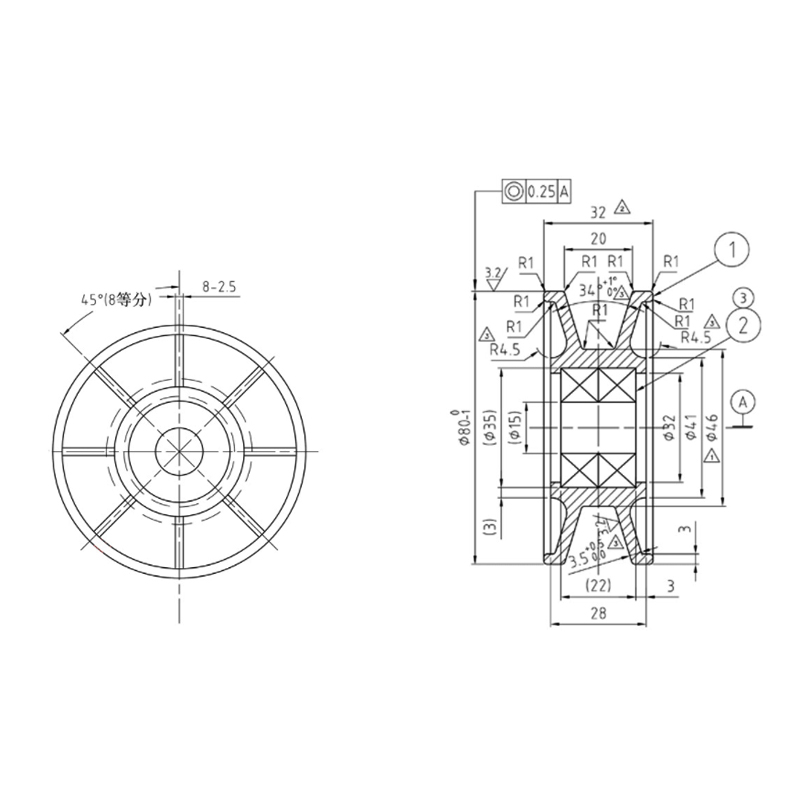 FKD-G514 V-Shaped Nylon Escalator RollerFor escalator drive paths needing a centred, low-friction interface, this V-shaped nylon roller with 6202 bearings and 80 mm outer diameter is worth reviewing.View Product →
Where weight and heat are concerns, an aluminium-core wheel can help the bearing run cooler and reduce rotating mass.
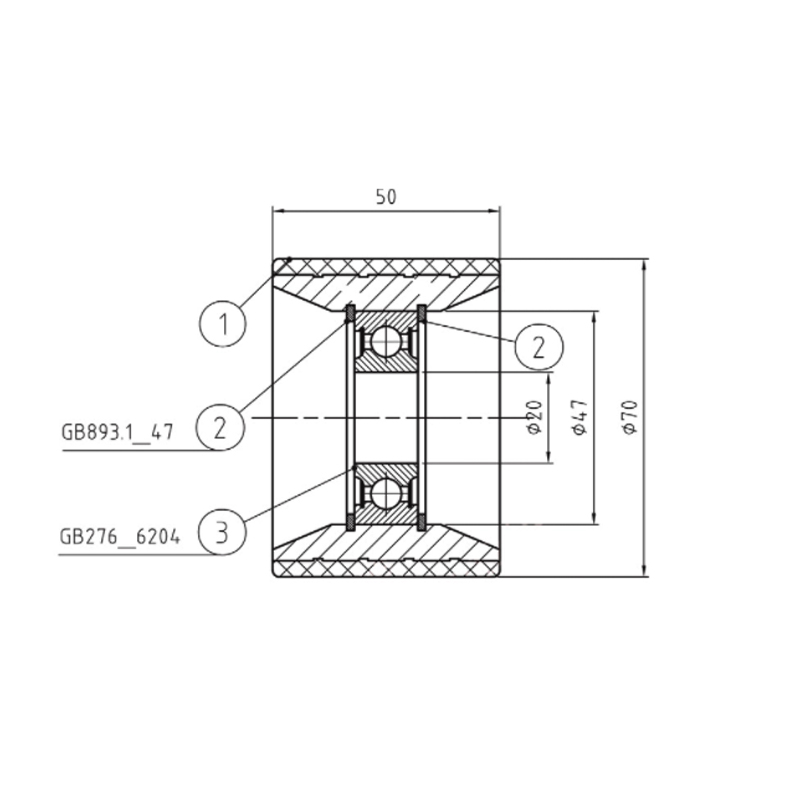 FKD-G609 Aluminum-Core Escalator RollerWhere weight and heat matter, this aluminum-core escalator roller has lightweight alloy core, 6204 bearings and 70 mm outer diameter to reduce rotating mass.View Product →
Failure Signs: What a Worn Guide Roller Sounds and Looks Like
A failing guide roller rarely announces itself with a clean break. It usually starts with a beat: a soft knock once per revolution, louder under load. Then come black dust under the track, a polished or stepped rail face, and a step chain that sits slightly off centre. In severe cases, the roller seizes and the chain slides, which raises motor current and can trigger a fault.
- Rhythmic knock or click that tracks with chain speed.
- Flat spot, shiny patch, or cracking on the tyre.
- Grease weeping from the seal, or a dry rusty bearing.
- Black rubber dust around the guide track.
- Chain tracking marks on one side of the rail.
- Uneven step spacing or handrail speed fluctuation.
A roller that spins freely but feels rough is already a bearing problem. A roller that will not spin is a seized bearing or a swollen tyre. Replace both sides as a set when wear is uneven; mixing a new roller with a worn one shifts the load and accelerates the next failure.
A structured inspection routine is covered in how to maintain escalator rollers.
Installation and Alignment Checks
Most premature guide roller failures start at installation. Before fitting a new roller, inspect the track for steps, burrs, and compacted debris. Check the shaft for wear and the housing for ovality. A new bearing on a worn shaft will develop play quickly.
- Isolate and lock out the escalator; confirm zero energy.
- Clean the guide track and inspect for ridges, impact damage, and old rubber deposits.
- Measure shaft diameter and housing bore; replace worn shafts rather than polishing them.
- Fit the roller with the correct spacer and seal orientation; do not force the bearing.
- Torque fasteners to the OEM value; check axial clearance by hand.
- Run the escalator at low speed and watch chain tracking; stop at any side load or unusual noise.
- Recheck after the first few hours of operation.
Alignment is not a one-person job on a long escalator. Use the OEM track gauge and confirm both sides of the chain are parallel. If the chain still drifts, inspect the guide rail, not just the roller. A new roller can mask a bent rail for a few weeks, then fail again.
Specifying Replacement Guide Rollers Without Guesswork
A repeatable specification beats a low unit price. For each replacement, record the drawing revision, outside diameter, face width, bore, bearing part number, tyre material and hardness, and shaft fit. Ask for a dimensional report and a batch code. For OEM or high-duty work, request a sample fit before releasing the batch.
Four procurement risks deserve attention:
- Mixed hardness between batches: quiet at first, noisy after a few months.
- Bearing play or seal drag: heat and current rise.
- Core material substitution: weight and heat path change.
- Undefined tolerance: rollers fit one escalator but not the next.
A supplier with a documented ISO 9001 process, traceable bearing sources, and measured batch records reduces these risks. That matters more on a transit escalator running 20 hours a day than on a low-rise unit in an office lobby.
Maintenance Plan That Matches Escalator Duty
Inspection frequency should follow duty, not calendar habit. A shopping-centre escalator with 12-hour daily service sees a different wear pattern from an airport unit at 20 hours or an outdoor unit exposed to rain and grit. Start with the OEM manual, then adjust based on measured wear.
Record roller diameter, noise, and chain tracking at each inspection. Replace when the tyre is below the OEM wear limit, the bearing has play, or tracking cannot be corrected by adjustment.
Keep a simple spares strategy: one set of guide rollers per escalator type, stored sealed and away from ozone sources. Do not store rubber rollers in direct sunlight or near electric motors.
Frequently Asked Questions
Q1. What is an escalator guide roller?
It is the wheel that guides the step chain or handrail drive chain along the track. It maintains alignment and reduces friction; it is not the same as a step roller that carries passenger load.
Q2. How do I know if my escalator guide roller is bad?
Listen for a rhythmic knock and look for black dust, side wear on the track, a flat spot, or a rough or seized bearing. Compare both sides; uneven wear usually means alignment or rail problems.
Q3. Can I replace an escalator guide roller by size only?
Only if size includes OD, face width, bore, shaft fit, bearing number, and hardness. A matching OD with the wrong bearing seal or hardness can fail early.
Q4. What is the difference between a guide roller and an escalator step chain roller?
A guide roller controls path and alignment; a step chain roller carries chain and passenger load. They run on different tracks and have different load ratings.
Q5. How often should escalator rollers be inspected?
Follow the OEM manual. As a starting point, high-duty transit units may need monthly visual checks, retail units every 1 to 3 months, and outdoor units more often.
Q6. When should I replace escalator rollers?
Replace when the tyre is below the wear limit, the bearing has play or roughness, the roller has a flat spot, or chain tracking cannot be corrected. Replace both sides as a set when wear is uneven.