
 English
 中文简体

A car that stops 200 mm below the floor, holds for a second or two, then creeps up to level is rarely a levelling fault. In most of the service reports we see from maintenance teams, that pattern comes from a single component: the landing elevator door interlock, the lock plus safety contact that has to prove every landing door is closed and locked before the controller releases the brake.
The conclusion first: the interlock is the only door component wired directly into the safety chain, so its condition decides whether the elevator runs, refuses to start, or stops between floors. Door operators, photocells and closing-force limiters affect comfort and door behaviour, but they cannot authorise travel. Only the interlock chain can do that.
Content
- 1 What an Elevator Door Interlock Is Made Of
- 2 The 7 mm Rule: Why Engagement and Contact Timing Must Match
- 3 Emergency Unlocking: What the Triangle Lock Really Does
- 4 Where Door Interlocks Fail in Service
- 5 A Short Inspection Routine That Catches Interlock Faults Early
- 6 Specifying a Replacement: Fit, Finish and Traceability
- 7 Elevator Door Interlock: Frequently Asked Questions
What an Elevator Door Interlock Is Made Of
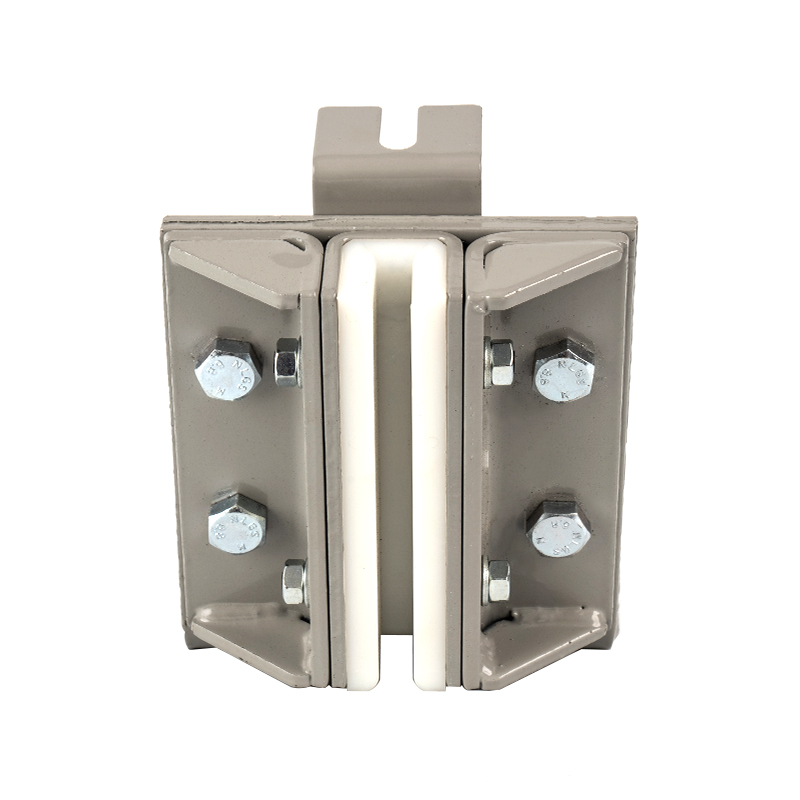
Mechanically, an interlock is a latch. A hook or roller on the landing door engages a keeper fixed to the door frame or to the lock body, holding the panel closed against a passenger's push and the return force of the door closer. Electrically, it is a positive-opening safety contact built into the same housing. The two halves are deliberately linked: the contact may only close once the latch has reached its designed engagement, and it must break as soon as the latch starts to disengage.
A complete unit normally contains five elements. When a fault is intermittent rather than permanent, the table below is usually the fastest way to narrow it down.
| Component | Role in the interlock | Typical symptom when worn |
|---|---|---|
| Locking hook or roller | Holds the landing panel closed against the door-closing force | Door springs open a few millimetres; car refuses to start |
| Keeper or hook plate | Provides the engagement surface and sets the 7 mm dimension | Engagement falls below specification as the plate wears or shifts |
| Safety contact block | Sends the "locked" signal into the safety chain | Car stops between floors, then re-levels after a pause |
| Emergency release lever | Allows unlocking from the landing with a triangle key | Key turns but the door stays locked; lever binds |
| Return spring and fixings | Re-latches the hook after every door cycle | Lock fails to re-engage; door recycles repeatedly |
Some jurisdictions also require a car door interlock. The working principle is identical, but the mechanical arrangement differs: on most European and Chinese installations the car door is monitored by its own contact rather than a true mechanical lock, while North American codes treat the car door interlock as a separate device. If you are sourcing across markets, confirm which of the two the customer's code actually asks for.
The 7 mm Rule: Why Engagement and Contact Timing Must Match
EN 81-20 sets the reference most buyers in Europe work to, and China's GB/T 7588.1 series follows the same principle: the locking element must engage by at least 7 mm in the closed position, and the electrical safety contact must not close until that engagement exists. In the other direction, the contact must break before the hook has travelled far enough to release the door. Installations in North America follow ASME A17.1/CSA B44, which applies its own engagement and unlocking-zone values, but the underlying logic is the same: the electrical proof and the mechanical lock must never fall out of step.
Why specify 7 mm instead of "it feels closed"? Because engagement is a wear dimension. A hook and keeper that start at 9 mm lose a fraction of a millimetre with every cycle. After a few hundred thousand door operations, a 6 mm engagement still looks locked, still passes a hand-pull test, and still trips the safety chain on a cold morning when the door sags by another millimetre. A feeler gauge and a one-line record sheet catch that problem long before a passenger does.
Two practical consequences follow. First, when replacing a lock, replace or at least measure the keeper as well; a new hook on a worn plate often lands short of the dimension even though everything was fitted correctly. Second, contact timing is set by housing geometry, so pairing a lock body from one supplier with a lever or cam from another is a false economy — the parts may bolt together and still break the safety chain at the wrong moment.
Emergency Unlocking: What the Triangle Lock Really Does
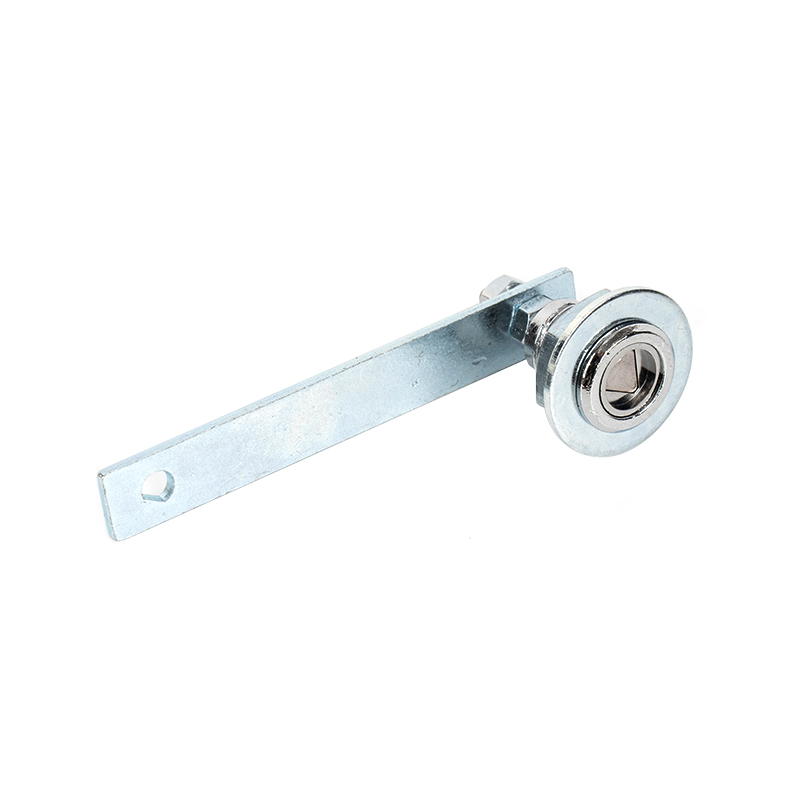
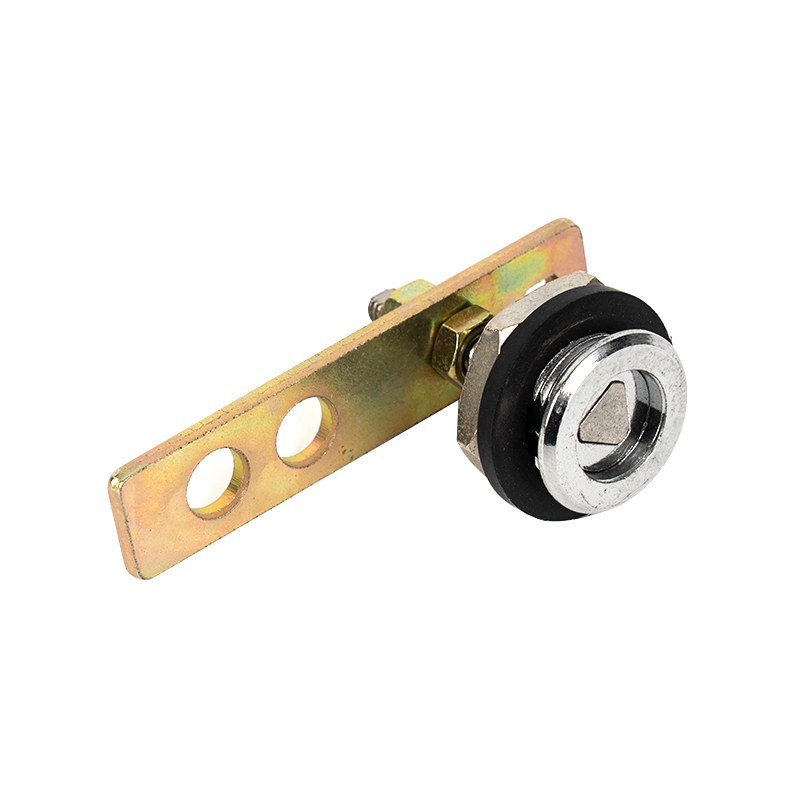
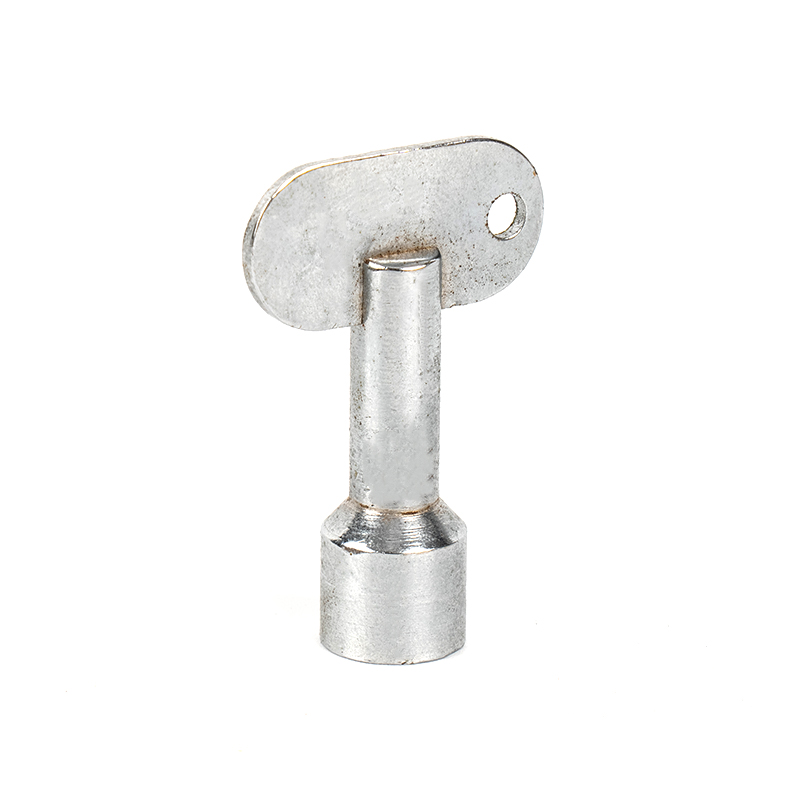
The triangle lock on the landing door is the emergency release of the interlock, not a security lock. Turning the triangle key retracts the hook so that a technician can open the panel from the landing for rescue, inspection or maintenance. EN 81-20 restricts this to an unlocking zone of roughly 0.20 m above or below the landing level, so that a door cannot be released onto an empty hoistway with the car parked two floors away.
Triangle spindles are not interchangeable. Hitachi, Mitsubishi, Otis, Kone, Thyssen and the Chinese domestic brands use different spindle lengths, cam profiles and mounting hole pitches, so a key that turns one lock will not necessarily release another. For maintenance contractors carrying a single key ring across a mixed portfolio, the practical answer is to match the release to the lock actually installed rather than to force a universal fit.
For retrofit work where the original brand plate has disappeared, a dimensioned generic assembly is often the quickest starting point.
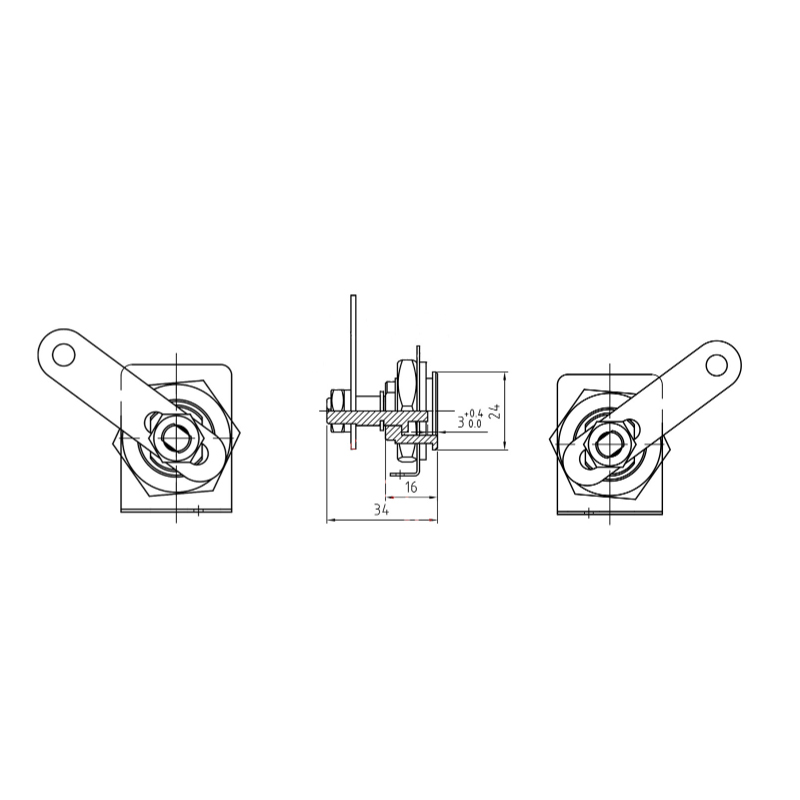 FKD-0073 Elevator Floor Door Triangular LockA generic floor-door triangular lock for retrofit starting points when original brand details are unavailable; useful before reviewing common landing-door lock failures.View Product →
Where Door Interlocks Fail in Service
Field experience with landing door locks keeps producing the same short list of failures. They are ordered below by consequence rather than by frequency.
- Bridged or welded contacts. A jumper wire, a taped-over joint or a contact that has welded closed tells the controller the door is locked when it is not. This is the failure that kills people, and it is also the one an inspection can find in seconds by tracing the safety chain.
- Worn hook or keeper. Engagement drops below the code minimum and the car develops the classic stop-and-creep behaviour, usually on one landing only.
- Misalignment after door sag. Building settlement or a bent panel tilts the landing door until the hook binds; the door re-opens and the car refuses to start at that floor.
- Contaminated contact faces. Grease from over-lubrication, concrete dust or condensation raises resistance, and the chain reads open at random intervals.
- Broken return spring or loose fixing. The hook no longer re-latches after the door closes, so the fault appears only after a full door cycle.
- Corrosion in damp hoistways. Car park levels and semi-outdoor shafts attack plated steel; sealed contacts and stainless bodies last considerably longer.
A Short Inspection Routine That Catches Interlock Faults Early
The checks below take a couple of minutes per landing and follow roughly the same sequence a code inspection would.
- Measure engagement with a feeler gauge between hook and keeper, and write the value down. Below specification, replace rather than adjust.
- Verify contact timing: the safety contact closes only after full engagement, and opens before the hook releases the door.
- Trace the safety chain for bridges, doubled ferrules or taped joints at the lock terminals.
- Operate the triangle key release; the lever should move freely, release the hook, and re-latch on the spring without help.
- Clean contact faces dry. Grease and graphite attract dust and insulate the very circuit you are relying on.
- Check fixings and the vertical alignment of the panel; a lock that binds is usually a door that has moved.
- Log the measurement and the date. Three readings across a year show wear long before it becomes a call-out.
The cleaning and lubrication points around the release mechanism are covered in our guide to daily maintenance of elevator triangle locks, which pairs well with the routine above.
Specifying a Replacement: Fit, Finish and Traceability
Three details decide whether a replacement interlock works first time.
- Fit. Hole pitch, spindle length, cam angle and terminal block position. Photograph the old unit next to a ruler; a 2 mm pitch difference is enough to make a lock unusable on site.
- Finish and material. Zinc-plated steel for dry shafts, stainless or sealed bodies for car parks and humid climates, with a dust-protected contact block.
- Traceability. Ask for a dimensional drawing, the contact rating and a statement of conformity to the relevant standard. A supplier who cannot provide drawings cannot support a fleet that mixes several brands.
Brand-specific assemblies remove most of the guesswork. A Hitachi landing door lock, for example, has to match the panel cut-out and the existing key cam, otherwise the release will not line up with the permitted unlocking zone.
 FKD-7335 Hitachi Elevator Floor Door Triangle LockHitachi-compatible floor-door triangle lock in four A-D types, offered for matching panel cut-outs and key cams in brand-specific landing-door assemblies.View Product →
Kone installations use their own hook geometry and mounting pattern, and combining a Kone-compatible cam with a generic body tends to produce a lock that latches but releases badly.
 Kone-Compatible Elevator Floor Door Triangle LockKone-compatible floor-door triangle lock with corrosion-resistant construction and prying/shearing resistance; view when brand-specific hook geometry and mounting pattern must align.View Product →
When the original brand is unknown, work from the triangle lock assembly range and match by dimensions and photographs rather than by the name on the door.
Elevator Door Interlock: Frequently Asked Questions
The interlock is one of the cheapest parts in the shaft and the one that decides whether the car moves at all. Measure engagement instead of trusting the click, match the release to the brand already installed, and keep the numbers on file. That record is what turns an intermittent call-out into a planned replacement.