
 English
 中文简体
中文简体
If your escalator is producing unusual noise — grinding, clicking, rattling, or a persistent humming — the root cause is most likely a worn, damaged, or poorly lubricated escalator roller. This is the single most common mechanical finding in escalator maintenance inspections worldwide, yet it is routinely misdiagnosed as a motor, chain, or track issue until a qualified technician physically inspects the roller assemblies. Addressing roller problems early prevents progressive damage to adjacent escalator components, reduces downtime risk, and extends the overall service life of the equipment.
This article explains exactly why escalator rollers cause noise and vibration, how to identify the specific symptoms, what replacement and sourcing options exist, and how a structured maintenance program prevents these issues from recurring. Whether you are a facility manager, elevator maintenance contractor, or procurement professional sourcing escalator spare parts, the information below is directly applicable to your situation.
Content
- 1 Why Escalator Rollers Are the Most Likely Source of Noise
- 2 How to Diagnose Escalator Roller Problems: Symptoms and Indicators
- 3 Understanding Escalator Roller Types and Specifications
- 4 How Often Should Escalator Rollers Be Replaced?
- 5 Escalator Maintenance Checklist: Roller-Focused Inspection Protocol
- 6 Sourcing Escalator Rollers: What to Evaluate in a Supplier
- 7 About Ningbo Yinzhou Fukangda Elevator Parts Factory
- 8 Frequently Asked Questions
Why Escalator Rollers Are the Most Likely Source of Noise
An escalator contains dozens of individual rollers distributed across step chains, handrail systems, and track guidance assemblies. Each roller is a precision-engineered component that operates under continuous cyclic load — typically completing thousands of revolutions per hour during normal operation. Over time, the bearing inside the roller degrades, the tread material wears unevenly, or the roller core deforms under impact loads. Any of these failure modes produces audible noise and/or mechanical vibration that passengers and operators can detect.
Industry data from elevator and escalator service organizations consistently identifies roller-related issues as responsible for 40–55% of all escalator mechanical complaints, making them the leading single category of escalator maintenance parts consumed globally. The prevalence is driven by the sheer quantity of rollers in a single unit (a typical escalator contains 80–120 step rollers plus additional handrail and track rollers), the harsh contact-load environment they operate in, and the sensitivity of rolling bearings to contamination, lubrication failure, and misalignment.
The Four Primary Roller Failure Modes
- Bearing fatigue: The inner bearing races develop spalling or pitting after extended cyclic loading, producing a characteristic rhythmic clicking or grinding sound that increases in frequency as speed rises.
- Tread wear: Polyurethane (PU) or nylon tread material wears down unevenly, creating flat spots that generate a repetitive thumping or knocking noise synchronized with roller rotation.
- Core cracking or deformation: The metal or polymer core develops cracks under repeated impact, particularly in heavy-duty installations. This produces irregular rattling or intermittent loud impacts.
- Lubrication failure: Dry bearings run metal-on-metal, producing high-pitched squealing that is often the first audible warning sign before structural bearing damage occurs. This is the most preventable failure mode.
The horizontal bar chart above shows the approximate distribution of escalator roller failure modes based on aggregated field maintenance data from commercial escalator service environments. Bearing fatigue is the dominant failure mode at approximately 40% of cases, followed by tread wear at 27% — together accounting for nearly two-thirds of all roller-related maintenance interventions. Lubrication failure, at 18%, is the most consequential given that it is almost entirely preventable with a disciplined maintenance schedule. Core deformation at 15% is more common in high-traffic installations such as transit stations and airports where impact loads exceed the design assumptions for standard-duty rollers, pointing to the importance of specifying heavy duty escalator roller components in high-footfall environments.
How to Diagnose Escalator Roller Problems: Symptoms and Indicators
Accurate diagnosis is the prerequisite for effective repair. Escalator noise and vibration complaints are often described vaguely by building occupants, so maintenance technicians need a structured approach to trace symptoms back to specific roller assemblies. The following symptom-to-cause mapping provides a practical diagnostic reference.
| Symptom | Sound Character | Most Likely Cause | Inspection Action |
|---|---|---|---|
| Rhythmic clicking | Repeats with step cycle | Bearing spalling or flat spot on tread | Mark steps; isolate which roller produces the click |
| Continuous high-pitched squeal | Constant, speed-related pitch | Dry bearing / lubrication failure | Check lubrication; apply approved grease; re-test |
| Intermittent loud thump | Irregular, impact-type | Cracked roller core or debris in track | Inspect all rollers visually; check track for obstructions |
| General vibration / shaking | Felt through steps and handrail | Multiple worn rollers; misaligned step chain | Full roller set inspection; check chain tension |
| Handrail noise / vibration | Localized to handrail area | Worn handrail guide rollers | Inspect handrail roller assemblies at return sections |
| Noise only at upper/lower landing | Localized to transition zones | Curved track roller wear at bends | Inspect transition zone rollers and track curvature |
Visual Inspection: Signs of Worn Escalator Rollers
Beyond acoustic diagnosis, a physical visual inspection of roller condition provides definitive evidence of wear status. Trained technicians look for the following indicators during routine escalator maintenance parts inspections:
- Tread surface diameter measurably reduced from original specification (typically more than 1.5mm wear warrants replacement)
- Visible flat spots, gouges, or uneven tread wear patterns
- Free-spin resistance when manually rotating the roller by hand (indicates bearing damage)
- Visible cracks in the tread material, particularly at the roller edge or around the axle bore
- Discoloration or heat marking on the roller surface (indicating dry-run overheating)
- Grease contamination with metallic particles visible under close inspection
Understanding Escalator Roller Types and Specifications
Not all escalator rollers are interchangeable. A typical escalator installation uses multiple distinct roller types, each engineered for a specific position in the mechanical system. Sourcing the correct specification for each position is critical — installing a step roller in a handrail position or specifying the wrong diameter creates alignment problems that generate their own noise and accelerate wear. Understanding the roller taxonomy is therefore essential for any procurement professional or maintenance contractor working with escalator spare parts.
Main Step Rollers
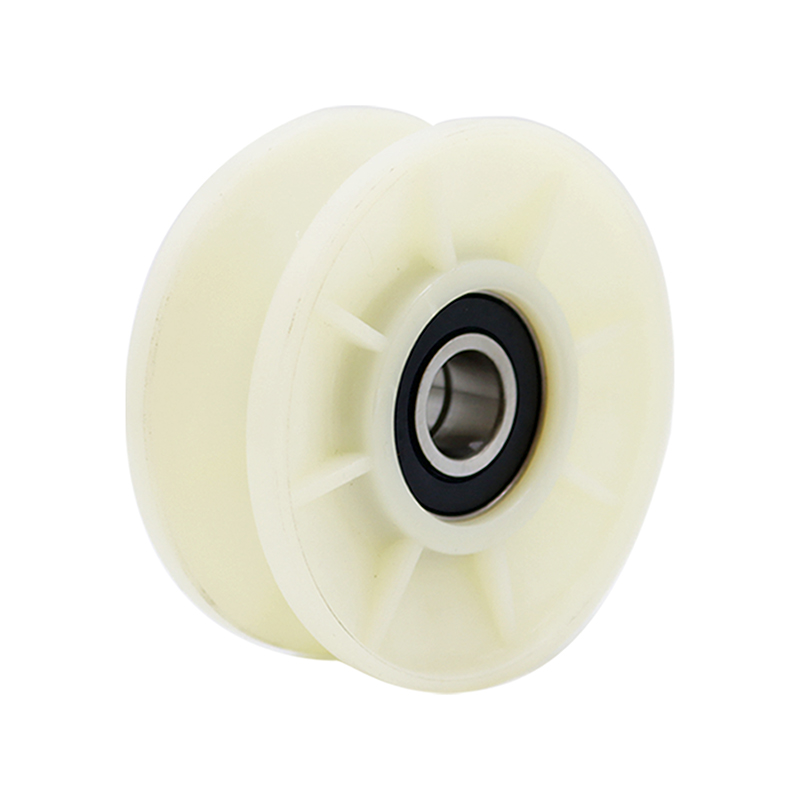
Step rollers support the weight of the step itself plus passenger loading as the step travels along the main track system. These are the highest-load rollers in the system and are most commonly constructed with a polyurethane (PU) tread over a steel or polymer core with a sealed precision bearing. Common outer diameters range from 70mm to 100mm depending on escalator model. PU escalator rollers have become the industry standard for step positions due to their superior load capacity, noise damping properties, and wear resistance compared to older nylon tread designs.
Chain Rollers and Guide Rollers
Chain rollers are integrated into the step chain links and run along the chain track to manage chain tension and directional guidance. Guide rollers are positioned at the sides of the step to prevent lateral movement and maintain the precise alignment required for safe comb plate engagement at the landing plates. Both types operate in the mid-to-lower load range compared to step rollers but in some of the highest-speed zones of the escalator's mechanical path.
Handrail Drive Rollers
Handrail drive rollers are part of the friction drive system that moves the rubber handrail at a speed synchronized with the step speed. These rollers operate under significant friction and tension loads and require materials with high coefficient of friction and resistance to heat buildup. Wear in handrail drive rollers typically presents as handrail speed mismatch — the handrail running faster or slower than the steps — which is both uncomfortable for passengers and a safety concern.
The radar chart above compares polyurethane (PU) step rollers against standard nylon rollers across six performance dimensions relevant to escalator maintenance engineers and procurement teams. PU rollers score significantly higher on load capacity, noise damping, wear resistance, and operational lifespan — the four dimensions most directly linked to maintenance cost and passenger experience. Nylon rollers score slightly higher on heat tolerance in extreme-temperature environments but are otherwise outperformed across the board. This explains the industry-wide transition to PU rollers as the standard specification for new installations and replacement programs in most markets. When sourcing from a PU escalator roller factory, buyers should confirm the specific PU compound hardness (typically 85–95 Shore A for step rollers) and bearing grade (ABEC-3 or better for commercial escalator applications) to ensure performance equivalence with OEM specifications.
How Often Should Escalator Rollers Be Replaced?
Replacement intervals for escalator rollers are not fixed universal values — they depend on traffic volume, operating hours, environmental conditions, roller material grade, and whether a proactive lubrication program is in place. The following guidance represents widely observed replacement intervals across different installation categories:
| Installation Type | Daily Operating Hours | Typical Roller Life | Recommended Inspection Interval |
|---|---|---|---|
| Transit / Metro Station | 18–24 hrs | 2–3 years | Every 6 months |
| Airport / Terminal | 18–24 hrs | 2–4 years | Every 6 months |
| Shopping Mall | 12–16 hrs | 4–6 years | Annually |
| Office / Commercial Building | 10–14 hrs | 5–8 years | Annually |
| Hotel / Retail (Low Traffic) | 8–12 hrs | 6–10 years | Every 18 months |
It is important to note that these intervals assume quality-grade rollers, a structured lubrication program, and normal operating conditions. Rollers operating in environments with high dust, humidity, or chemical exposure (such as food courts or industrial facilities) should be inspected more frequently. When any noise or vibration symptom is detected, do not wait for the next scheduled inspection — conduct a targeted diagnostic review immediately, as progressive roller damage can accelerate track wear and create secondary component failures that are significantly more costly to repair.
The column chart above visualizes the stark difference in expected roller lifespan between high-intensity transit and airport installations versus lower-traffic commercial environments. Transit and airport escalators average 2.5–3 years between full roller replacements — meaning procurement teams for these facilities need to maintain standing supply agreements with a reliable escalator roller supplier wholesale to avoid extended equipment downtime during repair cycles. Office and hotel installations, by contrast, can achieve 6–8 years between replacements with proper maintenance, making them suitable for periodic restocking arrangements. This data underscores why one-size-fits-all maintenance contracts are often poorly suited to facilities with different escalator operating profiles, and why facilities managers should define replacement schedules specifically for each installation rather than applying portfolio-wide averages.
Escalator Maintenance Checklist: Roller-Focused Inspection Protocol
A structured maintenance approach is the most effective tool for preventing roller-related noise complaints before they develop into serious mechanical failures. The following checklist covers the essential inspection and servicing tasks organized by frequency — suitable for building maintenance teams, contracted service providers, and in-house escalator technicians.
Monthly Inspection Tasks
- Listen to escalator operation across the full step cycle and log any new noise or vibration patterns
- Visually inspect accessible step rollers for tread surface condition, cracks, or discoloration
- Check lubrication points and apply approved grease to bearing lubrication fittings where present
- Inspect track surfaces for unusual wear patterns or debris accumulation that could accelerate roller wear
Quarterly Inspection Tasks
- Measure tread diameter on a sample of step rollers and compare against OEM minimum specification
- Manually spin each accessible roller to check for bearing drag, roughness, or resistance
- Inspect handrail drive roller condition and verify handrail speed synchronization with step speed
- Check chain roller alignment and tension; misaligned chains accelerate chain roller wear disproportionately
- Document all measurements in a maintenance log for trend analysis over time
Annual Full Inspection Tasks
- Complete roller set inspection — measure and document the condition of every roller in the installation
- Replace all rollers showing tread wear beyond OEM minimum or bearing degradation as a set
- Inspect and clean track surfaces; remove any oxidation or contamination that creates abrasive contact
- Verify that replacement escalator components used during the year match the original specifications
- Review the maintenance log for emerging trends that may indicate systematic issues beyond individual roller wear
The line chart above tracks the relationship between roller wear progression and audible noise level over a 36-month operating period on a typical commercial installation without a proactive maintenance program. The critical insight is that noise levels remain relatively low through the first 18–20 months as wear accumulates gradually, then escalate sharply in the final third of the roller's service life. This non-linear relationship is why facilities managers who rely on noise complaints as the trigger for maintenance action are often responding only after significant wear damage has already occurred — frequently at a point where track damage and chain wear have also developed alongside the roller degradation. The orange threshold line in the chart represents the point at which replacement should ideally be initiated based on measurement rather than noise — crossing this threshold with a reactive-only maintenance approach typically results in a 30–40% higher total repair cost due to secondary component damage. A proactive maintenance schedule anchored to measurement data, rather than symptom onset, is the clear operational best practice for any facility seeking to manage escalator maintenance parts costs effectively.
Sourcing Escalator Rollers: What to Evaluate in a Supplier
The quality of replacement escalator spare parts directly determines how long your repair solution lasts. Substandard rollers installed to address a noise problem frequently fail within 12–18 months, requiring the same repair cycle to be repeated at significant additional cost. For procurement professionals and facility managers sourcing escalator rollers — whether for a single unit repair or a large-scale fleet replacement program — the following evaluation criteria should guide supplier selection.
Material and Manufacturing Standards
Quality heavy duty escalator rollers are manufactured to precise dimensional tolerances with tread materials that meet defined hardness, abrasion resistance, and compression set specifications. For PU rollers, the polyurethane compound should be specifically formulated for dynamic rolling contact applications — not repurposed from static sealing or cushioning compounds. Bearing quality is equally important: sealed precision bearings with ABEC-3 or ABEC-5 rating offer significantly longer service life than commodity-grade bearings, particularly in contaminated or high-moisture environments.
OEM Compatibility and Custom Configuration
Many escalator installations use proprietary roller dimensions specified by the original equipment manufacturer. When sourcing from a custom escalator roller OEM supplier, confirm the supplier's capability to match exact diameter, width, bore size, bearing specification, and axle tolerance for the specific escalator model. A supplier with full in-house machining and molding capability can typically replicate any OEM dimension, whereas distributors relying on standard catalog stock cannot. For large fleet operators, working with an escalator roller manufacturer China that offers custom tooling can provide both cost efficiency and dimensional precision that matches OEM specifications exactly.
Production Scale and Supply Chain Reliability
Escalator downtime is costly — both in direct repair cost and in the operational impact on building occupants. A reliable escalator roller supplier wholesale should be able to demonstrate consistent production capacity, maintained safety stock of high-volume SKUs, and reliable international logistics capability. Suppliers with ISO 9001-certified quality management systems provide documented process controls that reduce batch-to-batch dimensional variance — a key concern when ordering rollers across multiple production runs for an ongoing fleet maintenance program.
The chart above reflects the relative importance ratings that experienced escalator maintenance procurement professionals assign to supplier selection criteria. OEM dimension accuracy tops the list at a maximum score of 10, reflecting the fundamental requirement that replacement rollers must fit precisely within the tolerances of the original equipment design — even small dimensional deviations create alignment issues that generate the very noise problems the replacement is intended to fix. Material grade and bearing specification rank second and third, underscoring that the internal quality of the roller matters as much as its external dimensions. Lead time reliability ranks fourth, a pragmatic priority for maintenance contractors who cannot afford extended equipment downtime. Certification compliance (ISO, CE, or equivalent) ranks fifth — important for regulated environments and quality-managed procurement programs. Custom OEM capability, while ranked sixth here, becomes the paramount criterion for large fleet operators and elevator OEMs who require precisely replicated components across diverse installation types.
About Ningbo Yinzhou Fukangda Elevator Parts Factory
Founded in 2006 and headquartered in Da'ao Industrial Park, Yinzhou District, Ningbo City, Zhejiang Province, China, Ningbo Yinzhou Fukangda Elevator Parts Factory is a professional manufacturer and factory specializing in the research, development, production, and sales of elevator and escalator components. The company serves as a dedicated escalator roller manufacturer and escalator spare parts supplier with an established track record in the domestic and international elevator industry.
Fukangda's production center operates advanced hardware and plastic processing equipment, mature assembly production lines, and systematic inspection procedures — providing effective quality assurance for high-precision, high-performance escalator components. These manufacturing capabilities support consistent supply chain delivery for customers requiring reliable ongoing parts availability.
The company has developed mature cooperation experience with domestic first-line elevator brands, supplying escalator maintenance parts and custom-configured roller assemblies to demanding OEM customers across the elevator industry. Fukangda's production capabilities encompass standard catalog escalator rollers, custom OEM configurations, and heavy-duty variants suitable for high-traffic installations — all manufactured to the dimensional and material specifications required by professional escalator service and maintenance programs.
Frequently Asked Questions
Q1: Why is my escalator making noise?
In most cases, escalator noise is caused by worn, dry, or damaged step rollers. Other possible causes include chain tension issues, misaligned guide tracks, or debris on the running surface. A systematic roller inspection is the recommended first diagnostic step.
Q2: What causes escalator vibration when running?
Escalator vibration is typically caused by multiple worn rollers creating uneven load transfer across the step chain, flat spots on tread surfaces, or chain tension imbalance. In heavy-traffic installations, core deformation in rollers is a common contributing factor that requires replacement of affected rollers as a set.
Q3: How do I fix escalator roller noise?
First, determine the specific noise character (clicking, squealing, thumping) and location to identify which roller assembly is affected. If the bearing is dry, lubrication may provide temporary relief. However, physically worn rollers must be replaced — lubrication alone cannot restore a roller with damaged bearing races or flat tread spots.
Q4: How often should escalator rollers be replaced?
Replacement intervals depend on traffic volume and daily operating hours. Transit and airport escalators typically require replacement every 2–3 years; shopping mall escalators every 4–6 years; office building escalators every 5–8 years. Annual inspection is the minimum recommended frequency for any commercial installation.
Q5: What are the signs of worn escalator rollers?
Key signs include visible flat spots or uneven tread wear, resistance when manually spinning the roller, surface cracking or discoloration, rhythmic noise during operation, increased vibration across the step surface, and tread diameter measurably below the OEM minimum specification.
Q6: How do I lubricate escalator rollers correctly?
Use only the grease type specified in the escalator's service manual — typically a lithium-complex or NLGI Grade 2 grease for sealed bearings. Apply through the bearing lubrication fitting if present. Avoid over-lubrication, which attracts dust and contaminates bearing surfaces. Sealed bearing rollers without lubrication fittings cannot be field-lubricated and must be replaced when bearing noise develops.
Q7: Can I source custom-sized escalator rollers from a manufacturer?
Yes. Reputable escalator roller manufacturers offer custom OEM configurations matched to specific escalator models, including exact diameter, bore size, bearing specification, and tread material. Minimum order quantities typically apply for custom tooling. Provide the OEM part number or dimensional drawing when requesting a quotation.
Q8: What is a PU escalator roller and why is it better?
A PU (polyurethane) escalator roller uses a polyurethane tread compound over a steel or polymer core. Compared to older nylon rollers, PU rollers offer superior load capacity, lower noise levels, better wear resistance, and longer service life under dynamic contact loads — making them the current industry standard for step roller applications in most commercial escalator installations.