
 English
 中文简体

A worn elevator sheave rarely announces itself. It shows up first as a ride complaint at one landing, a rope that has crept out of level, or a car that slips slightly during a no-load brake test. By the time the grooves look polished and the rope sits lower than it did at handover, traction has already dropped and the ropes are working harder than they were designed to.
The conclusion first: specify and inspect a sheave on three numbers and one habit, namely the D/d ratio, the groove profile, the rim material, and a groove-wear measurement at every annual service. Price and lead time matter, but they seldom cause a call-back. Those four do.
Content
- 1 A Sheave Is a Friction Joint, Not a Lifting Pulley
- 2 Groove Geometry Decides Rope Life Before Material Does
- 3 Cast Iron, Steel or Polymer: Match the Rim to the Duty
- 4 Fit, Alignment and the Tolerances That Get Skipped
- 5 Wear Signals and the Point Where Replacement Beats Re-Machining
- 6 Elevator Sheaves: Frequently Asked Questions
- 6.1 What is an elevator sheave?
- 6.2 Traction sheave or diverter sheave — what is the difference?
- 6.3 What D/d ratio should an elevator sheave have?
- 6.4 How do I know when an elevator sheave needs replacing?
- 6.5 Can worn sheave grooves be re-machined?
- 6.6 Do polymer or nylon sheaves last as long as cast iron ones?
A Sheave Is a Friction Joint, Not a Lifting Pulley
Every sheave is a wheel with a groove, but the three types found in a typical traction installation do different jobs, and confusing them puts the wrong spare on site.
- Traction sheave — bolted to the geared or gearless machine and driven by it. It transmits torque to the ropes through friction alone. Rope speed follows v = π × D × n / 60, where D is the pitch diameter at the rope centreline and n is machine rpm, so a few millimetres of diameter change becomes a measurable change in car speed and levelling.
- Diverter or deflector sheave — redirects the ropes, usually without drive torque. Each one adds a reverse bend, and reverse bends are what consume rope fatigue life.
- Idler pulleys — used in 2:1 and 4:1 roping to double or quadruple rope speed; they carry load but transmit no drive torque.
The ratio to check first is D/d, pitch diameter over nominal rope diameter. EN 81-20 links the minimum sheave diameter to rope diameter and rope construction, and D/d = 40 is the usual floor for traction sheaves in passenger duty. Drop below it and rope bending stress climbs quickly: the rope can pass its break test and still fail early in service with broken outer wires.
Groove Geometry Decides Rope Life Before Material Does
Three profiles cover most traction work, and the trade-off is always the same: more traction means less rope life.
| Groove profile | Traction | Rope life | Typical use | Watch point |
|---|---|---|---|---|
| Semicircular (U) | Lowest | Longest | Freight and high-duty passenger, comfortable ride | Slips early if the groove wears or ropes are over-lubricated |
| Undercut V with relief | Medium-high | Medium | Most machine-room-less passenger units | Undercut must be machined correctly, not worn in |
| Full V | Highest | Shortest | Low-speed, low-rise, restricted headroom | Rope pressure and groove wear climb fast |
Groove condition matters more than groove type. Once the rope sinks below its original seat, the contact angle changes, the rope ovalises and traction falls. The machine compensates with more current, the rim runs hotter, and the wear accelerates.
The same guided-contact idea appears outside the machine room. Our V-profile rollers for escalator step chains and drive systems are machined to hold a chain or rope in a defined seat instead of letting it ride on a flange; the escalator roller range shows the family.
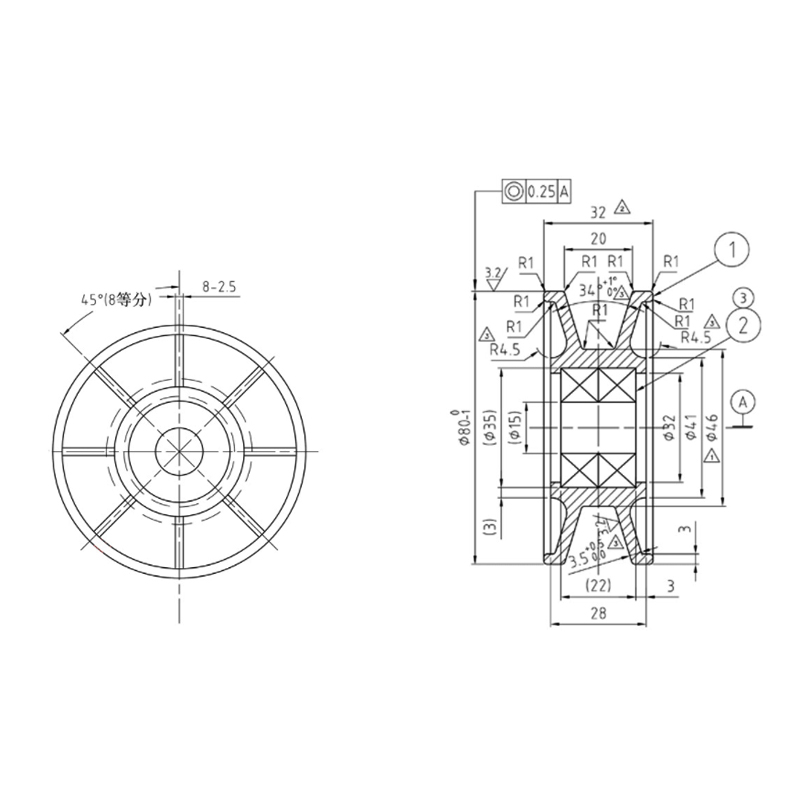 FKD-G514 Nylon V-Shaped Escalator RollerNylon V-shaped escalator roller with 80 mm diameter, 30 mm height and 6202 bearings, suited to guided contact in step-chain and drive applications.View Product →
Cast Iron, Steel or Polymer: Match the Rim to the Duty
Rim material sets how much pressure the groove can take, how much noise the machine makes, and how the sheave behaves once a rope starts to slip.
- Grey cast iron (HT250 / GG25) — the default choice. It machines cleanly, holds a groove profile, damps vibration and typically runs at 170–220 HB, which suits most traction sheaves up to medium load.
- Nodular (ductile) iron — higher tensile and impact strength for thin rims and high rope pressure.
- Steel — welded or rolled rims for large diameters, heavy duty and high-speed gearless machines; groove hardness must be controlled carefully.
- Polymer or nylon rim on a metal core — roughly one-sixth the density of iron, quieter, corrosion-free and gentle on ropes. The limits are heat build-up, lower pressure capacity and groove creep when rope load is underestimated. Common in villa lifts, escalators and small MRL machines.
Weight often decides the job on modernization work: a polymer-rimmed wheel on an aluminium hub can be carried and fitted by one technician without reinforcing the bracket. The trade is a lower traction ceiling, so the groove needs measuring more often, not less. It is the same reason aluminium-core wheels have become standard in escalator duty.
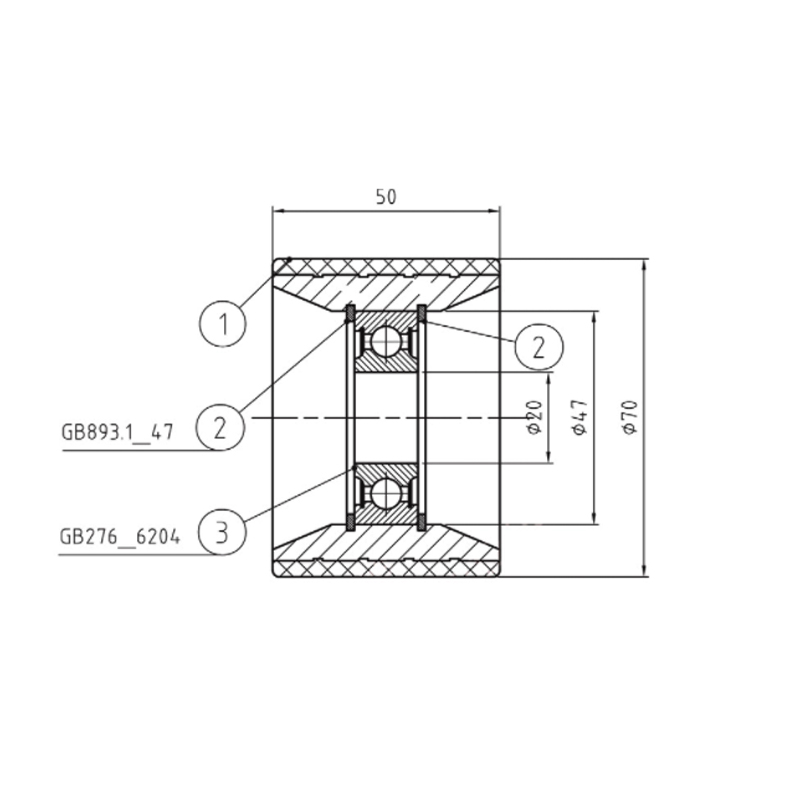 FKD-G609 Aluminum-Core Escalator Roller WheelAluminum-alloy-core escalator roller measuring 70 mm by 50 mm, offering a lighter wheel for modernization work where handling and bracket load matter.View Product →
Fit, Alignment and the Tolerances That Get Skipped
Most short sheave lives we are asked to diagnose start at installation, not at the foundry.
- Bore and key fit. An H7 bore with a parallel key is normal, but check that the sheave does not rock on the shaft before final torque. A rocking sheave wears its keyway and runs out of plane within a season.
- Plumb and plane. Check the sheave face with a dial gauge or precision level; OEM manuals usually quote a limit in the region of 0.5 mm per metre. Miss it and the rope walks sideways in the groove on every trip.
- Rope tension equalisation. Measure each rope and bring them within about 5%. Unequal tension wears the grooves unevenly and lets the slack ropes slip under load.
- Fleet angle and groove alignment. The rope must sit in the groove at both ends of travel without touching a flange or riding the rim edge.
- Guarding clearance. Rope guards should not touch the rim, and there must be room for the rope to settle deeper as the groove wears.
Treat those as shop-floor targets and let the OEM manual override them. When a sheave is noisy or a rope jumps under load, one of the five is almost always behind it.
Wear Signals and the Point Where Replacement Beats Re-Machining
Groove wear is measurable. A groove gauge, a rope diameter reading and a runout check settle most arguments about whether a sheave is finished.
| Finding | What it means | Response |
|---|---|---|
| Rope sits visibly low in the groove; gauge reads past the limit | Contact angle lost, traction falling | Re-cut only if rim material remains, otherwise replace |
| Rope diameter well under nominal, broken wires clustered near the sheave | Fatigue from small D/d or reverse bends | Replace the rope and review sheave diameter |
| Uneven groove depth across the rim | Rope tension imbalance or fleet angle | Equalise tension, re-align, then machine or replace |
| Whine or thump in the machine room | Bearing wear or rim runout | Measure runout and bearing play before touching grooves |
Re-machining is a legitimate repair, but it is a one-time budget. Every cut reduces the pitch diameter, changes rope speed and removes the hardest layer of the groove surface; after one or two clean-up passes most fleets are better served by a new sheave. Rope-side discard rules follow ISO 4344 / EN 12385-6 general guidance, while sheave-side limits come from the OEM manual and the groove gauge, not from the calendar.
Elevator Sheaves: Frequently Asked Questions
What is an elevator sheave?
A grooved wheel that carries the hoist ropes. On a traction lift the driven one is the traction sheave; the others only redirect or support the ropes.
Traction sheave or diverter sheave — what is the difference?
The traction sheave is connected to the machine and moves the car by friction. A diverter sheave only changes rope direction, adds a reverse bend and transmits no torque.
What D/d ratio should an elevator sheave have?
EN 81-20 sets the minimum from rope diameter and construction. D/d = 40 is the usual floor for passenger traction duty; higher ratios are chosen where rope life matters more than compactness.
How do I know when an elevator sheave needs replacing?
Rope slip under load, a groove gauge reading past the OEM limit, uneven groove depth, or rim runout with bearing noise. Measure before deciding; vibration alone proves nothing.
Can worn sheave grooves be re-machined?
Yes, within limits. Pitch diameter shrinks, traction and rope speed change, and the hardened surface layer is lost, so most manuals allow only a small clean-up before replacement.
Do polymer or nylon sheaves last as long as cast iron ones?
In low-pressure duty such as villa lifts and escalators they can, and they run quieter. Under high rope pressure or sustained heat, cast iron or steel still lasts longer.